A MONSTER LIKE ME by Pamela Sparkman

Heart of Darkness series #2

HELLO STRANGER by Lisa Kleypas

The Ravenels series #4

THE BUTTERFLY PROJECT by Emma Scott

Companion to the Full Tilt series

PLAYING FOR KEEPS by Jill Shalvis

Heartbreaker Bay series #7

UNWRITTEN by Jen Frederick

Woodlands series #5

Cross My Heart by L.H. Cosway

Hearts series #5.75

MOONSHADOW by Thea Harrison

Moonshadow series #1

Showing posts with label women's fiction. Show all posts

Sunday, March 5, 2023

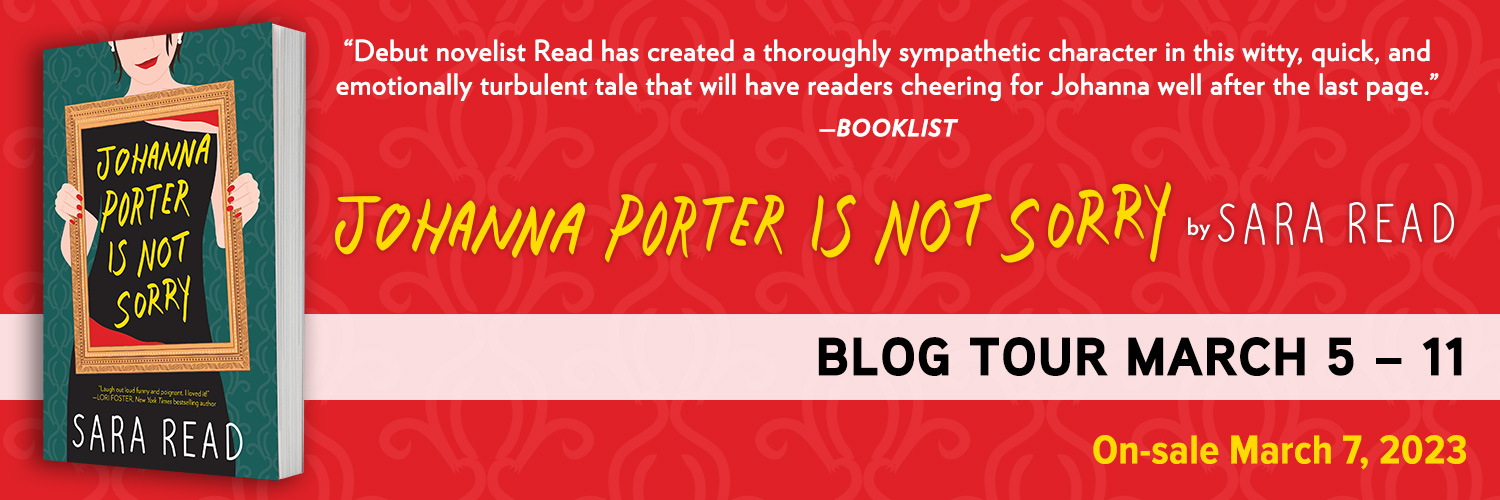
Blog Tour with Excerpt: Johanna Porter is Not Sorry by Sara Read


The headlines dubbed it the art heist of the decade…


JOHANNA PORTER IS NOT SORRY 
by SARA READ

Series: n/a
Publication date: March 7, 2023
Published by: Graydon House / Harper Collins
Genre: women's fic

 Add on Goodreads


SYNOPSIS

Twenty years ago, Johanna Porter was a rising star in the art world. Now she’s an unknown soccer mom. When an invitation arrives for an elite gallery opening for her former lover, the great Nestor Pinedo, Johanna wants to throw it in the trash where it belongs. But with some styling help from her daughter, she makes an appearance and comes face-to-face with the woman she was before the powerful and jealous Nestor ruined her.

La Rosa Blanca is a portrait of Johanna herself, young and fierce and fearless—a masterwork with a price tag to match. When she cuts it out of its frame, rolls it up and walks out, Johanna is only taking back what was stolen from her.

Hiding out with La Rosa Blanca in a shack on the Chesapeake Bay, Johanna digs into the raw work of reviving her own skills while battling novice-thief paranoia, impostor syndrome and mom guilt. But Johanna doesn’t just want the painting—she wants to paint again. To harness her powerful talent, she must defy everyone’s expectations—most of all her own—for what a woman like her should be.


Purchase your copy now!
Amazon |  B&N | Bookshop | BAM 


Excerpt

The Pinedo family cordially invites you
to a private party to celebrate the opening of
the Nestor Pinedo Retrospective.
Friday, January 20. Nine o’clock.
Shimon-West Gallery,
North Capitol Street, Washington, DC.

Johanna,
I do hope you will join our little gathering. Father is finally starting to feel his age and hopes very much to see you again. There are so few friends left from the old days. Time comes for us all, no?
Saludos,
Pilar

     Fuck their party. Fuck this expensive invitation which some unpaid intern probably agonized over for weeks. Fuck Nestor Pinedo and his retrospective. Fuck Pilar Pinedo and her little personal note in her elegant handwriting. Fuck their amazing champagne and their interesting friends and all of Nestor’s glorious paintings.
     Fuck all of it. I am not going.
There’s half a bottle of the good whiskey left in the cabinet above the fridge. I climb up there for it, then pour a glass, neat. Here’s to telling Pilar and her heartless troll of a father to piss off. I slap the invitation down on the counter, which is none too clean, cross my arms and stare at it, as if it’s not quite safe to turn my back.
     Dear Pinedos, Johanna Porter warmly requests your presence at leave-me-the-fuck-alone.
Dear Pilar, For the sake of the young women in attendance, please ensure that Nestor keeps his withered old dick in his pants. My regrets.
     Dear Nestor, My body will already be present on your canvases. The presence of my Self was never particularly important.
     She doth protest too much—I know that’s what you’re think­ing. And yes, I doth. (Have you ever tried this whiskey, Tem­pleton? It’s delicious.)
     A preopening party? Friends from the old days? Since when was I a “friend”? Not since twenty years ago, and even then—not exactly how I would characterize myself and Nestor. And Pilar hates my guts.    Yet I still can’t throw this invitation in the trash where it belongs.
     Johanna Porter disrespectfully declines.
     There will be no paintings by me at that show, but there will be paintings of me. I refill my glass. As much as I detest Nestor and Pilar, they form a direct line to the years when I was on fire. When I felt my own greatness. When I very nearly made it real.
     But I failed. The fire is dead. I’m nobody. They are invit­ing me back inside—god knows why—but all that’s in it for me now is great champagne and beautiful people and big, clean galleries full of someone else’s art.
     I hate galleries. They make me want to cry.
     It’s not that I didn’t like to sell. I was good back then. I held a six-figure check with my name on it once. But now no one knows me. Not even me. I snatch that sophisticated square of cardstock from the counter, sloshing liquor on my wrist in the process.
     Boo-hoo. Pity the unfulfilled housewife. That’s what you’re thinking now, right? I am not a housewife. I’m a single mother with a job. But fine, I am unfulfilled. The very peo­ple inviting me to this party strangled my career—my call­ing—in its cradle. It’s been twenty years of exile and decline ever since. (Okay, I am getting drunk and dramatic. So be it.)
     Actually, let’s call it nineteen years of exile and decline, overlaid with seventeen years of my baby girl, Mel. That’s her, clomping down the hall to our apartment, still wear­ing her cleats from practice. I set my drink and the invita­tion on the counter and try to clear up the frown lines I can feel on my face.
She drops her duffel bag by the door and comes to the kitchen. Seventeen years old, nine feet tall, and built like the goddess of the hunt with a face to match. Not exactly, but that’s how she reads to a room. More like five nine, all long, lean muscle, and glorious hair. She towers over me as I hug her firm, sapling waist.
     “Any plans tonight?”
     At least half the time Mel comes over for her weekends, she takes a shower, transforms herself from warrior-athlete to sweet-smelling ingenue with a few swipes of powder and a hair tie, and is back out the door before I can even get a good look at her.
     “Nothing tonight.” She heads for the refrigerator. “You coming on Sunday?”
     Home game at ten. “Yep. I’ll be there.”
     She drinks some milk straight from the carton and forages a cheese stick from the dairy drawer.
     “What’s the matter?” she says, not even looking at me.
     “What do you mean?”
     “Mom.” She turns and raises an eyebrow. I have never been able to do that.
     They say predators can smell fear. Mel Porter can smell ex­istential distress. If I’m just pissy about the dishwasher being broken, she barely notices. But if something is grating at my soul, she’s all over it.
I pick up the invitation. Holding it up by a corner, I let her read it.
     Her brow crinkles. “I thought he was dead.”
     “Not dead. Just old.”
     “Who’s Pilar?”
     “His daughter. And publicist. She hates my guts.”
     “So why the note?”
     “My question exactly.”
     She takes the invitation and turns it over. Looks at the matte detail from an early Pinedo on the back. Chews her cheese stick in contemplation. “Are you going?”
     “I don’t know.” I may be expert at lying to myself, but I’ve never been any good at it with Mel.
     She looks at me with those teddy-bear brown eyes. I wish I’d had half her emotional intelligence when I was her age. Or now, for that matter.
     “What if you looked really smoking hot?”
     I can’t help a good laugh at that. “Mel, this body does not do smoking hot.”
     “It could. I mean for your age, with the right dress and some badass boots?”
     I am writing mental Fuck you notes. Mel is already going shopping.
 
     Mel goes to bed early, giving me some alone time as I get ready for bed myself.
     If it were just an invitation to see Nestor—a dinner or a cocktail party or something—I wouldn’t still be thinking about it. But it’s a gallery. And not just any gallery. Shimon-West is the elite gallery in the city. A shrine where Art and Money go to get married. No matter the passage of time, I am not over the lure of a place like that.
     My invitation does not include a plus-one. I would gate-crash a date, but honestly it would all be too much to explain, even to Mel. If I go, it’s just easier to go alone, even if I have to manufacture a smile and carry the weight of heartbreak in my chest the whole night.
     Hanging on the wall in my room is a painting I did a year and a half after Nestor. As I’ve done many times before, I take it down and hold it in my lap. It’s only twenty by thirty and unframed. A self-portrait, mother and child, me and my Amelia. My baby Mel.
     No, she’s not Nestor’s baby. She’s Ben’s baby. As much as a girl can be like her father Mel is, down to the big dreamy eyes and the shimmer of anxious energy.
     I painted this one looking in a mirror with Mel at my breast. A local collector offered me decent money for it at the time, but there was no way I’d part with it, then or now. It’s part of my soul. We have a weightless quality in this paint­ing, almost hovering, but with the gravity of Mel’s body on mine. Highly saturated shades of blue and purple predomi­nate. In the near background, a vase of red flowers bursts through the midnight tones. The brushstrokes are subtle and confident. The arrangement of our bodies has both languor and energy, and the way my head is tilted says everything about how wholly I loved Mel, but also how I was burdened.
     I shouldn’t, but I run my thumb over my signature—in that corner, the paint is wearing thin—then hang it back above my bed. My own mother died when I was seventeen. On my bureau I keep a picture of her in a glass frame. She is wearing ice skates and standing by the entrance to the rink, her cheeks pink with cold, and her smile winter-bright. I never got a chance to paint her portrait from life.
 
     In the morning, I startle awake to the sound of Mel mak­ing a smoothie in the kitchen. Staring hard at the ceiling, I contend with the truth.
     Right in the center of who I am, a fire once burned bright. It has been dormant a long time. Most of Mel’s life. She brought me a long way from the broken young woman I was, accidentally pregnant at twenty-six, but she is almost a woman herself now, and when I held that goddamn invi­tation to Shimon-West in my hand, an ember sparked and glowed to life. I tried to drown it with whiskey, but it’s te­nacious.    And it’s hungry for a source of fuel. Who am I kid­ding with my snark and resistance?
     I find Mel at the breakfast table, feet up, looking at her phone.
     “I’m going to that party.”
     She puts down her phone and claps her hands. “Yes. I knew it.”
     At a gallery party you either need to look like you make art or like you make money. Thus, smoking-hot women who used to be artists (“Still are, Mom”) do not go to private Pinedo parties in Gap dresses. Not even Anthro dresses. No. While working artists can and do wear practically whatever they want, smoking-hot women go to Pinedo parties in Ro­darte dresses, Miyake suits, and handmade shoes.
Mel understands this. She also understands that smoking-hot former artists who teach art at her high school do not shop anywhere within a mile of Rodarte, so she has located a consignment store downtown. I may still spend half my pay­check on a garment, but according to Mel we will achieve a high-class-kiss-my-ass look that will make me feel like I’m doing them a favor showing up at their fucking party.
If only a dress could do that. But I do know that a dress can buy a person that crucial hour of self-confidence that will get her through the door. And once I’m in, I’ll sip some champagne, flirt with rich men, and let the Pinedos see I’m fine, thank you very much.
It’s gray out but mild for January, and Mel and I take a comfortable walk with coffee in hand down the block from the subway. She finds the building and the narrow door, and she leads us up a flight of stairs to the boutique. The pro­prietress, sixtyish and slender with a gray updo and amazing eyeliner, nods at us as we enter.
     I’ve been in a lot of used clothing stores, and I have no idea how this one got rid of that smell that all the other ones have. Instead of dust and stagnation with an undertone of feet, this place smells like a boudoir. And it’s not jammed with clothes the way they always are. We move easily between racks of slacks, blouses, cocktail dresses, gowns, coats. The side wall is tastefully arranged with shoes and accessories, and win­dows in front let in a gentle light. Behind the antique desk that serves as a counter, a large reproduction of Beardsley’s strange art nouveau drawing John and Salome gives the whole place an air of sex and conflict. I love it here.
     Mel holds up a velvet minidress. I shake my head. I’m too old for mini. I examine the garments, feeling like I should have washed my hands. Gucci, Chanel, Ford, Herrera. I lift a long-sleeved black gown off the rack.
     Mel frowns. “You’re not going to a funeral.”
     “Can I help you find something?” the lady with the eye­liner says from her desk.
     Mel waves her over. The woman is about my height and less intimidating than I first thought.
     “She’s going to a private party at a fancy art gallery,” Mel says. “Like really upscale. And she hates everyone who’s going to be there, so she needs to look smoking hot. But not like she’s trying. Like she just is.”
     Lady Eyeliner laughs. Where Mel learned to talk to sales­people I have no idea. It has to be genetic, and not from my side. Mel is wearing slides, baggy sweats, and her father’s fleece pullover, and her bun is coming loose, but this so­phisticated woman takes to her immediately.
They stand me in front of a full-length mirror, and to­gether they size me up, clearly confident that they can pull this off. I wish I felt it myself. All I see are dark circles under tired eyes. Narrow shoulders and a smallness in my posture. A woman who does not command space. Mel brings over a dress that looks like a full-length slip in blood red. I shrink some more.
     Lady E understands me better. First a black strapless. She shakes her head before I have a chance to.    Too plain. She comes back with a military-style shirt dress. Mel grimaces.
     Finally I retreat to the fitting room and try on a minimalist gray knit. Too big. Then a color-block shift.      Not bad, but Lady E says, “Cliché.” I unzip myself from it and sit on an upholstered stool in my underwear. This is supposed to be fun, and I suppose it is. Fancy shopping with my daughter is always fun. But this time the fun competes with the voice inside that says Fraud. Poser. I could find the perfect dress, but all it will take is someone asking me that most miserable of cocktail-party questions, What do you do? for it to all fall apart.
     “Can you do one-shoulder?” Lady E calls from across the store.
     “I guess so.”
     In a moment she slips a black velvet dress through the door. The zipper is stiff and sticks in a couple of places as I get it open. Then I step in and shimmy the dress up over my hips.
     “Do you need help?” Lady E says. I crack the door, and she steps in.
As she works the zipper closed, the dress embraces my body like it’s known me carnally. Fitted around the ribs and waist, it angles from the shoulder sharply across the bust, showing one collarbone. The skirt is gathered at a seam below the waist where the velvet falls in sculptural folds.
     “What do you think?” Lady E smiles at my reflection. She turns me so I can see the back.
     “I think I like it.”
     “Oscar de la Renta.” Her voice is gentle, and I wish she were my friend. She smooths the skirt. “This wrap here is such a nice detail. Like an upside-down tulip.”
     I smile back at her. It’s the strangest thing, a dress like this. It makes me feel like it could be possible. It could even be fun.

    Excerpted from Johanna Porter is Not Sorry by Sara Read, Copyright © 2023 by Sara Read. Published by Graydon House Books. 


Praise for Johanna Porter is Not Sorry:

“Laugh out loud funny and poignant, this gem of a debut novel has it all, a messy soccer mom on the run, an art heist, dubious choices, and a heartwarming love story. I loved it! Sara Read is a writer to watch.”
—LORI FOSTER, New York Times bestselling author


ABOUT THE AUTHOR

Originally from Washington, DC, SARA READ tried the nine-to-five life for about a nanosecond before moving to rural Virginia to become a flute-maker’s apprentice and traditional fiddle player. Childbirth led her to a career in nursing. A cancer survivor herself, she now has the distinct privilege of caring for cancer patients. She is co-founder of #momswritersclub, a biweekly YouTube and live Twitter chat for writers. Sara lives in Charlottesville, Virginia, with her husband, two teens, a terrier, and three snarky cats. She loves a long run, a long road trip, and a long talk with a friend. www.sararead.net


You can find her on:

Friday, August 14, 2020

Blog Tour: The Dazzling Truth by Helen Cullen


One Irish family. Three decades. One dazzling story.


THE DAZZLING TRUTH by HELEN CULLEN
Series: Standalone
Publication Date: August 18, 2020 
Genre: women's fiction
Publisher: Graydon House Books

Purchase:
 Amazon | B&N | IndieBound | BAM | Harlequin

 Share on Goodreads


Synopsis

In the courtyards of Trinity College, Dublin, in 1978, aspiring actress Maeve meets pottery student Murtagh Moone. As their relationship progresses, marriage and motherhood come in quick succession, but for Maeve, with the joy of children also comes the struggle to hold on to the truest parts of herself.

Decades later, on a small Irish island, the Moone family are poised for celebration but instead are struck by tragedy. Each family member must find solace in their own separate way, until one dazzling truth brings them back together. But as the Moone family confront the past, they also journey toward a future that none of them could have predicted. Except perhaps Maeve herself.


Praise for The Dazzling Truth:

“Love is here in spades... clear a weekend for this gorgeous read.”
—Library Journal (STARRED REVIEW)

“Cullen’s lyrical prose drives the immersive and heart-wrenching narrative. This complex study of depression and its impact on family dynamics will lure readers.”
—Publishers Weekly

“With a group of well-crafted, intriguing characters, [Cullen] realistically portrays a tight-knit group of people trying to grow up and grow old under the shadow of a tragedy they can never understand. Readers will enjoy experiencing a slice of life in this small Irish community, and embrace the very interesting characters who live there.”
—Booklist

"Absolute poetry and a love letter to family and to the arts. The empathy in this book is beautiful.”
—Maggie Smith, award-winning author of Good Bones and Keep Moving

“A perfect combination of deeply felt tragedy with great hopefulness.”
—Anne Youngson, author of Meet Me at the Museum

“An extremely moving read. Helen Cullen handles the complexities of love, grief, family life and mental illness with sensitivity and depth. A truly gorgeous novel.”
—Ali Land, bestselling author of Good Me, Bad Me

“I devoured this, falling in love with the setting and with every character—and when I reached the end, I wept because it is just glorious. The Dazzling Truth is a sweeping family saga and at the same time, a close-up on the everyday beautiful details that make up love.”
—Emma Flint, author of Little Deaths

“A beautiful bittersweet story of love, loss and families all set in the most irresistible of locations. Tears were shed!”
—Graham Norton, BBC

“???????Cullen’s beautifully observed novel The Dazzling Truth charts a family across 37 years, living through a tragedy on a remote island; portraying mental health and the fall-out around it with enormous humanity and integrity. Tonally reminiscent of recent Colm Tóibín.”
—Caoilinn Hughes, author of Orchid and The Wasp and The Wild Laughter

“A beautiful novel. Helen Cullen writes with such deft care and attention about the things that hold us together when everything falls apart.”
—Rónán Hession, author of Leonard and Hungry Paul

“Helen Cullen is so wonderful on the Irish family and the utter complexity of motherhood, family entanglement and love. I was full on weeping at the end.”
—Elaine Feeney, author of As You Were

“In The Dazzling Truth, Cullen has woven a powerful and poignant narrative told over a lifetime; exploring unconditional love, heartbreak and the beautiful flaws of human nature set within a family unit. She is an astute and empathic writer and an incredible voice in Irish literature. You'll fall in love with the Moone family and they will linger in your heart long after you read the final pages.”
—Cat Hogan, author of They All Fall Down and There Was A Crooked Man

“The Dazzling Truth is such a tender read. Astute and compassionate, it made me cry. It’s full of love. And it’s quietly magnificent.”
—Tor Udall, author of A Thousand Paper Birds

“A beautifully observed saga of abandoned dreams, loss and self-discovery.”
—Alan McMonagle, author of Ithaca


EXCERPT

Inis Óg: 2005


Murtagh had woken that morning, once again, to an empty bed; the sheets were cool and unruffled on Maeve’s side. He had expected to find her sitting at the kitchen table, wrapped in her hound’s-tooth shawl, pale and thin in the darkness before dawn, a tangle of blue-black hair swept across her high forehead like a crow’s wet wing, her long, matted curls secured in a knot at the nape of her neck with one of her red pencils. He had anticipated how she would start when he appeared in the doorway. How he would ignore, as he always did, the few moments it would take for her dove-grey eyes to turn their focus outward. For the ghosts to leave her in his presence. The kettle would hiss and spit on the stove as he stood behind her wicker chair and rubbed warmth back into her arms, his voice jolly as he gently scolded her for lack of sleep and feigned nonchalance as to its cause.

But Maeve wasn’t sitting at the kitchen table.

Nor was she meditating on the stone step of the back door drinking milk straight from the glass bottle it was delivered in.

She wasn’t dozing on the living-room sofa, the television on but silent, an empty crystal tumbler tucked inside the pocket of her peacock-blue silk dressing gown, the one on which she had painstakingly embroidered a murmuration of starlings in the finest silver thread.

Instead, there was an empty space on the bannister where her coat should have been hanging.

Murtagh opened the front door and flinched at a swarm of spitting raindrops. The blistering wind mocked the threadbare cotton of his pyjamas. He bent his head into the onslaught and pushed forward, dragging the heavy scarlet door behind him. The brass knocker clanged against the wood; he flinched, hoping it had not woken the children. Shivering, he picked a route in his slippers around the muddy puddles spreading across the cobblestoned pathway. Leaning over the wrought-iron gate that separated their own familial island from the winding lane of the island proper, he scanned the dark horizon for a glimpse of Maeve in the faraway glow of a streetlamp.

In the distance, the sea and sky had melted into one anthracite mist, each indiscernible from the other. Sheep huddled together for comfort in Peadar Óg’s field, the waterlogged green that bordered the Moones’ land to the right; the plaintive baying of the animals sounded mournful. Murtagh nodded at them.

There was no sight of Maeve.

As he turned back towards the house he noticed Nollaig watching him from her bedroom window. The eldest daughter, she always seemed to witness the moments her parents had believed—hoped—were cloaked in invisibility, and then remained haunted by what she had seen. Ever since she was a toddler, Murtagh had monitored how her understanding grew, filling her up, and knew it would soon flood her eyes, always so questioning, permanently.

He waved at her as he blew back up the pathway. Later, he would feel the acute pain of finally recognising the prescience his daughter seemed to have absorbed from the womb.

‘How long is she gone?’

Nollaig was now standing before the hallway mirror, her face contorted as she vigorously tried to brush her frizzy mouse-brown hair into shape. She scraped it together into a tight ponytail that thrust from the back of her head as if it were a fox’s brush.

‘Ach, you should leave your gorgeous curls be, Noll,’ her father cajoled, ‘instead of fighting them.’

She smiled at him but slammed the mother-of-pearl hairbrush down on the sideboard.

‘I don’t have curls, I have Brillo pads,’ she sighed. ‘Did she say where she was going?’

Murtagh squeezed his daughter’s arm as he continued into the kitchen. ‘I’m sure your mother is just out for a walk. Happy birthday, love. Lá breithla shona duit.’

He placed a small copper saucepan of water on the range to boil and waved the invitation of an egg at his daughter. She nodded begrudgingly and curled into the green-and-gold striped armchair that sat in front of the stove.

‘With your white nightdress, you could almost pass for the Irish flag,’ he joked, and was gratified with her snort of glee.

He watched the clock hand count three minutes in silence. Expected any moment to hear his soaked wife splash through the door. He was poised, ready to run towards her with a towel and hushed reprimands for her careless wandering, but the boiling, cooling, cupping, cracking and spooning of each egg passed uninterrupted. Nollaig yawned, stretching her arms and legs before her in a stiff salute.

‘Why don’t you go back to bed for an hour?’ Murtagh asked. ‘We’ll all have proper breakfast together later.’

She eyed him with suspicion but acquiesced. ‘If Mam’s not back soon,’ she said, sidling away, ‘come and wake me. Promise? We’ll go out and find her. Remind her what day it is, for God’s sake.’

Murtagh nodded, ushered his daughter out of the kitchen and watched her climb the stairs.

Born on Christmas Eve, twenty years before, she was the only one of their children who came into the world via Galway maternity hospital and not into the impatient arms of Máire O’Dulaigh, the midwife of the island. She resented it; how it made her feel less of a true islander. What was more, the specialness of her own day for individual attention, her birth day, was irrevocably lost in the shared excitement of Christmas. In retrospect, it had been a mistake, perhaps, naming her Nollaig, the Irish for Christmas, and further compounding the association. No nickname had ever stuck, however. She wasn’t the sort of child who inspired others to claim her for their own with the intimacy of a given name.

‘Born ancient,’ her little sister, Sive, always said of her, with bored disdain.

And Murtagh sympathised. Nollaig carried the weight of being the eldest with pained perseverance, heavy responsibilities that were self-imposed. Her mother harboured a not always silent resentment of it, and it seemed only natural, if unfair, that Maeve and Sive gravitated more towards each other; the baby of the family shared her mother’s wit and wildness and often expressed the irritation her mother tried to hide at Nollaig’s sense of duty.


Excerpted from The Dazzling Truth by Helen Cullen, Copyright © 2020 by Helen Cullen.
Published by Graydon House Books


About the Author

HELEN CULLEN wrote her debut novel, The Lost Letters of William Woolf, while completing the Guardian/UEA novel writing program. She holds an MA in Theatre Studies from University College Dublin and is currently studying further at Brunel. Prior to writing full-time, Helen worked in journalism, broadcasting and most recently as a creative events and engagement specialist. Helen is Irish and currently lives in London.

Connect with the Author:

Thursday, July 16, 2020

Blog Tour: Paris is Always a Good Idea by Jenn McKinlay


A thirty-year-old woman retraces her gap year through Ireland, France, and Italy to find love—and herself—in this hilarious and heartfelt novel.


PARIS IS ALWAYS A GOOD IDEA by JENN MCKINLAY
Publication Date: July 21, 2020 
Genre: contemporary romance, women's fiction
Publisher: Berkley Books

Purchase:
 Amazon | B&N | BAM | iBooks | Google Play 

 Share on Goodreads


Synopsis

It's been seven years since Chelsea Martin embarked on her yearlong post-college European adventure. Since then, she's lost her mother to cancer and watched her sister marry twice, while Chelsea's thrown herself into work, becoming one of the most talented fundraisers for the American Cancer Coalition, and with the exception of one annoyingly competent coworker, Jason Knightley, her status as most talented fundraiser is unquestioned.

When her introverted mathematician father announces he's getting remarried, Chelsea is forced to acknowledge that her life stopped after her mother died, and that the last time she can remember being happy, in love, or enjoying her life was on her gap year. Inspired to retrace her steps--to find Colin in Ireland, Jean Claude in France, and Marcelino in Italy--Chelsea hopes that one of these three men who stole her heart so many years ago, can help her find it again.

From the start of her journey nothing goes as planned, but as Chelsea reconnects with her old self, she also finds love in the very last place she expected.


Praise for Paris is Always a Good Idea:

“A playful breezy read that I couldn't put down!”­--Abby Jimenez, USA Today bestselling author of The Friend Zone, on Paris Is Always a Good Idea

 “A delightful romance with characters I adored! Jenn McKinlay takes readers along on a fun and charming adventure in Paris Is Always a Good Idea.”--Emily March, New York Times bestselling author of Teardrop Lane

 “Eat Pray Love meets Mamma Mia! I devoured this clever novel in one sitting!"--Lori Nelson Spielman, New York Times bestselling author of The Star-Crossed Sisters of Tuscany, on Paris Is Always a Good Idea

“Delivers a fun, feel-good, stand-alone novel that will delight readers. [They] will savor the feisty, adventurous journey of McKinlay's self-deprecating protagonist as she re-examines her past in order to chart her future. Navigating many complications and bumps in the road, Chelsea finds romance and enlightenment over the course of her travels, and discovers how living life can change people--altering destinies, dreams and priorities for the better.”--Shelf Awareness, on Paris Is Always a Good Idea

 “Witty, warm and wonderful…an American Fleabag, told with heart, hope and joie de vivre.”--Lori Wilde, New York Times bestselling author of The Moonglow Sisters, on Paris Is Always a Good Idea

“McKinlay spins a funny yet poignant tale.”--Jen DeLuca, author of Well Met, on Paris Is Always a Good Idea

“A funny and charming romp of self-discovery…. You’ll feel like you’ve been on a European vacation even if you didn’t make it out of your own back yard.”--Kwana Jackson, USA Today bestselling author of Real Men Knit, on Paris Is Always a Good Idea

"Sparkles with wit yet is profoundly humane at its core. You will be rooting for Chelsea through all her travels."--Jenny Holiday, USA Today bestselling author of Mermaid Inn, on Paris Is Always a Good Idea

“Paris Is Always a Good Idea made me smile, cry, swoon, and cheer. It's a beautiful, funny, and relatable story about finding yourself.”--Sarah Smith, author of Faker

“This book ticked so many of my boxes: a perfectly imperfect protagonist on a bittersweet journey of self-discovery, relatable family tensions, vividly portrayed international settings, and an enemies-to-friends-to-lovers subplot that made me smile from ear to ear. A thoroughly satisfying read that tugged at my heart and made me happy-sigh when I reached the end!"--Mia Sosa, USA Today bestselling author of The Worst Best Man

“Readers will have no trouble investing in Chelsea and Jason’s enemies-to-lovers romance. This flawless rom-com is sure to delight.”--Publishers Weekly (starred review), on Paris Is Always a Good Idea

“McKinlay proves she is also a master at romantic women’s fiction with this dazzling novel that delivers everything McKinlay’s fans expect—deliciously acerbic wit, delightfully relatable characters, and deeply funny dialogue—all deftly poured into a plot that also thoughtfully examines what true happiness really means.”--Booklist


About the Author

Jenn is the New York Times, USA Today, and Publisher's Weekly bestselling author of several mystery and romance series and will be debuting a stand alone romantic comedy in July 2020 entitled PARIS IS ALWAYS A GOOD IDEA. She lives in sunny Arizona in a house that is overrun with kids, pets and her husband's guitars.

Connect with the Author:

Friday, July 10, 2020

Review: The Lost and Found Bookshop by Susan Wiggs


In this thought-provoking, wise and emotionally rich novel, New York Times bestselling author Susan Wiggs explores the meaning of happiness, trust, and faith in oneself as she asks the question, "If you had to start over, what would you do and who would you be?"


THE LOST AND FOUND BOOKSHOP
 by SUSAN WIGGS
Series: Bella Vista Chronicles #3
Publication date: July 7, 2020
Published by: William Morrow
Genre: women's fiction

 Add on Goodreads


SYNOPSIS

There is a book for everything . . .

Somewhere in the vast Library of the Universe, as Natalie thought of it, there was a book that embodied exactly the things she was worrying about.

In the wake of a shocking tragedy, Natalie Harper inherits her mother’s charming but financially strapped bookshop in San Francisco. She also becomes caretaker for her ailing grandfather Andrew, her only living relative—not counting her scoundrel father.

But the gruff, deeply kind Andrew has begun displaying signs of decline. Natalie thinks it’s best to move him to an assisted living facility to ensure the care he needs. To pay for it, she plans to close the bookstore and sell the derelict but valuable building on historic Perdita Street, which is in need of constant fixing. There’s only one problem–Grandpa Andrew owns the building and refuses to sell. Natalie adores her grandfather; she’ll do whatever it takes to make his final years happy. Besides, she loves the store and its books provide welcome solace for her overwhelming grief.

After she moves into the small studio apartment above the shop, Natalie carries out her grandfather’s request and hires contractor Peach Gallagher to do the necessary and ongoing repairs. His young daughter, Dorothy, also becomes a regular at the store, and she and Natalie begin reading together while Peach works.

To Natalie’s surprise, her sorrow begins to dissipate as her life becomes an unexpected journey of new connections, discoveries and revelations, from unearthing artifacts hidden in the bookshop’s walls, to discovering the truth about her family, her future, and her own heart.


Purchase your copy now!
Amazon | iBooks  | B&N | BAM | Google Play | Kobo 


Praise for The Lost and Found Bookshop:

"A wonderful exploration of the past and the future and, most importantly, of what it means to be present in the here and now.  Full of the love of words, the love of family, and the love of falling in love, The Lost and Found Bookshop is a big-hearted gem of a novel that will satisfy and entertain readers from all walks of life.  Lovely!"
Garth Stein, New York Times bestselling author of The Art of Racing In The Rain

“What a warm and deeply satisfying story! Reading it is like feeling the summer sun after a long winter.”
Erica Bauermeister, New York Times bestselling author of The Scent Keeper


ABOUT THE AUTHOR

Susan Wiggs's life is all about family, friends...and fiction. She lives at the water's edge on an island in Puget Sound, and she commutes to her writers' group in a 17-foot motorboat. She serves as author liaison for Field's End, a literary community on Bainbridge Island, Washington, bringing inspiration and instruction from the world's top authors to her seaside community. (See www.fieldsend.org) She's been featured in the national media, including NPR's "Talk of the Nation," and is a popular speaker locally and nationally.

According to Publishers Weekly, Wiggs writes with "refreshingly honest emotion," and the Salem Statesman Journal adds that she is "one of our best observers of stories of the heart [who] knows how to capture emotion on virtually every page of every book." Booklist characterizes her books as "real and true and unforgettable." She is the recipient of three RITA (sm) awards and four starred reviews from Publishers Weekly for her books. The Winter Lodge and Passing Through Paradise have appeared on PW’s annual "Best Of" lists. Several of her books have been listed as top Booksense picks and optioned as feature films. Her novels have been translated into more than two dozen languages and have made national bestseller lists, including the USA Today, Washington Post and New York Times lists.

The author is a former teacher, a Harvard graduate, an avid hiker, an amateur photographer, a good skier and terrible golfer, yet her favorite form of exercise is curling up with a good book. 

Follow her:
Website | Goodreads | Twitter | Facebook | Instagram


REVIEW

The Lost and Found BookshopThe Lost and Found Bookshop by Susan Wiggs
My rating: 5 of 5 stars


What a wonderful treat this story was! I picked it because of the charming setting in a bookshop, but I wasn't really prepared for how that bookshop would become almost a character of the story in and of itself. This wasn't just a building filled with books, it was Natalie and her mother's home, her grandfather Andrew's, past generations before that. The long line of family members that lived there each had a separate story that melded into one unified whole. Stories of tragedy, heartbreak, hope, fortunes lost and found, and meaningful life lessons. Natalie distanced herself as an adult from the bookshop, feeling as if it would only be a source of financial insecurity as it was in her childhood. What she learned by the end was that by letting go of her need to feel safe and control her life, she found the happiness and fulfillment at home she had always been missing.

    Natalie knew she’d been too afraid to live her life. She had sold it to the firm for a big salary. But what she’d really sold was her own happiness.

After Natalie loses her mother and the man she's dating in a plane crash, she's filled with a million emotions at once. Of course she's overcome with grief, but it's mixed with guilt, an irrational sense of responsibility for their deaths, and maybe even a little bit of resentment towards her mother. The two of them had a rocky relationship, and there were many times she felt disappointed by her, but with the suddenness of her death there was no ability to resolve the distance that had been between them. When she discovered what had happened and immediately came home to her grandfather, the reality of what her mother was taking care of all by herself hits her hard. My heart was aching for all of the pain she was going through. Her helplessness was overwhelming, and there were times she felt she would crack from the stress, but she forced herself to be strong for her grandfather.

    Blythe was gone, suddenly and irretrievably, like a zephyr shooting into the night sky, leaving a trail of moonlit particles that swirled in brief, unspeakable beauty, and then faded into nothing.

Natalie's grandfather, Andrew Harper, was a single father who took his responsibility seriously. He was unlucky in love, but found happiness where he could in his life. When his daughter Blythe came home from college pregnant and abandoned by the father, he immediately stood by her and her granddaughter as well. He was solid, strong, and dependable, and a shoulder to lean on when they needed it. I had barely been introduced to him and I already had tears in my eyes reading the funeral from his perspective. The author does an amazing job bringing you into each character's thoughts and emotions. What really struck me as special was getting Andrew's viewpoint as he struggles with early stages of dementia.

    His days started to fade, and his life turned as thin as lukewarm water. He was a ghost in a world that appeared through a glass that was ash-colored and wavy.

Often in books, we're only given the perspective of the family members who have to come to terms with their loved one's illness. But with Andrew, we simultaneously learn some of his life history as his memories slowly trickle away from him. We feel his confusion and devastation as his lucid moments flicker on and off. It was truly heartbreaking for everyone involved, but they vow to treasure what moments they do have left instead of mourning what they're losing.

On top of taking care of her grandfather's medical issues, Natalie has the monumental task of figuring out if saving the bookshop from financial ruin is possible. The debt seems absolutely insurmountable, but her Andrew is determined to stay where his family's roots are. So she takes the first necessary step and starts some much needed repairs on the building. Peach Gallagher is the man her mother hired for the job. When he shows up one day to get started, she has a mini-breakdown in front of him and he takes it all in stride. From his very first scene, you can see that he's compassionate and caring, making me like him immediately. Not only did he not shy away from comforting her while she grieved, but he was sensitive and kind to Andrew during his times of confusion. Natalie eventually started feeling stirrings of attraction towards him because of his kindness and the ease she felt with him, however she never let it go anywhere because she believed he was married. In actuality, Peach is a single father, just like her grandfather was. He has many of the same wonderful qualities, but his divorce is still fresh enough that he isn't looking for romance.

The slow burn romance is very much secondary to Natalie's personal transformation and how she comes to learn what's truly important in her life. She used to think that having a retirement fund, a stable job, and a nice apartment would give her everything she's ever wanted. Yet she was unhappy with her romantic relationships, her co-workers hated her, and her job bored her to tears. Running the bookshop again allowed her to step in her mother's shoes and see the joy she was able to bring to people's lives through books. She remembered the wisdom her mom imparted on her growing up, and it gave her comfort and strength.

I was addicted to this book while reading it, and found it very hard to put down. There were so many different layers to it that were beautifully presented. The writing was exquisite, emotional, and I know for sure that this story will stay with me for a long time. If I had one constructive criticism it would be that Peach and Natalie's eventual romance is rushed at the end, moving from friends, to a declaration of feelings, to an engagement almost instantly. However, it honestly didn't bother me and the story was so special that I couldn't contemplate giving less than five stars. I loved getting the family history piece by piece through antiques and other surprising items found during renovation. Secrets were unearthed, and emotional wounds were healed along the way. This is my first read by Susan Wiggs, but I plan to read many more of her books in the future. I can't recommend this one enough to anyone looking for an emotional, thought-provoking read.


FOLLOW SMOKIN HOT BOOK BLOG ON: 

TwitterBlogEmailGoodreadsPinterestFacebook


Tuesday, June 23, 2020

Spotlight: Return to Magnolia Harbor by Hope Ramsay


USA Today bestselling author Hope Ramsay delivers the next book in her Moonlight Bay series, an enemies-to-lovers story about a man who returns home to his small town and finds love in the most unlikely of places.


RETURN TO MAGNOLIA HARBOR by HOPE RAMSAY
Series: Moonlight Bay #3
Publication date: June 23, 2020
Published by: Forever
Genre: Contemporary Romance, Women's Fiction

 Add on Goodreads


SYNOPSIS

She never forgot him...but can she forgive him?

Jessica Blackwood is trying to make her architectural design firm a success, and she's off to a great start, thanks to a recommendation that leads to the job of the century-designing a house for a wealthy but reclusive bachelor. The only problem? Jessica's new client happens to be her old high school nemesis. The bigger problem? He's no longer the cocky boy who once tormented her, and suddenly she finds herself intrigued by her new client.

Christopher Martin isn't proud of his past behavior. He regrets nothing more than hurting Jessica all those years ago, and now that he's back in Magnolia Harbor he finally has a chance to make amends. As the two work side by side, Topher begins to realize he wants more than a house. He wants forgiveness and a future with the woman he's never forgotten. But can he prove to Jessica he's truly changed?

Purchase your copy now!
Amazon | iBooks  | B&N | Kobo | Google Play 


Praise for Hope Ramsay:

"Ramsay paints a quaint portrait of Magnolia Harbor and its earnest, salt-of-the-earth denizens, but she doesn't shy from drama and drops in a few deliciously hateable villains to liven up the tale. This cozy small-town romance will please Ramsay's fans and should attract new ones."―Publishers Weekly

"Every story by Hope Ramsay will touch a reader's heart."―Brenda Novak, New York Times bestselling author

"Happiness is a new Hope Ramsay series."―Fresh Fiction


ABOUT THE AUTHOR

Hope Ramsay is a USA Today bestselling author of heartwarming contemporary romances, set below the Mason-Dixon Line. Her children are grown, but she has a couple of fur babies who keep her entertained. Pete the cat, named after the cat in the children’s book, thinks he’s a dog. Daisy the dog thinks Pete is her best friend except when he decides her wagging tail is a cat toy. Hope lives in the medium-sized town of Fredericksburg, Virginia and when she’s not writing or walking the dog, she spends her time knitting and noodling around on her collection of guitars.

Follow her: